Showing posts with label Process: Being Ambidextrous. Show all posts

Monday, October 24, 2016

How growth champions create new value


Interesting take on what we covered in our Org Growth Class. Strongly recommend you read the full article

http://www.mckinsey.com/business-functions/marketing-and-sales/our-insights/now-new-next-how-growth-champions-create-new-value?cid=other-eml-nsl-mip-mck-oth-1610

Three horizons of action for creating new growth
NOW initiatives find growth through new niches within categories, segments, and markets. NEW actions focus on developing new products and services. NEXT initiatives capture organic growth from new business models 
NOW initiatives focus on new ways to generate growth quickly. This could mean selling an existing product in a new channel or market, launching a product variant, rejuvenating a core product by infusing it with new meaning, or opening up micromarkets. NOW initiatives have a high likelihood of impact, often require relatively little effort, and take a rather short time to implement. They represent a company’s “bread-and-butter business,” as one CMO described it 
NEW initiatives take something that works and use it as the basis for innovation, i.e. launch a new product, expand a brand into a new category, or address new segments. Because NEW initiatives venture beyond existing business, analyzing the market as it is won’t be enough. Identifying unmet needs and spotting NEW opportunities require being close to consumers and customers 
NEXT initiatives try out new business models, explore disruptive ideas, and create things from scratch. Often they take a lot of time and energy and have highly uncertain outcomes. But if they work, they can have huge impact. Disruptors, such as Uber, AirBnB, and Netflix, are leading the way in this respect.


We also found that “growth champions” tend to exhibit the following characteristics: 
They take a structured approach to creating and managing their portfolio of growth initiatives. “You have to be systematic when going after revenue growth.
They use advanced analytics and agile insights techniques to spot opportunities. They don’t expect to come up with market-beating ideas by looking at the same data in the same way as their competitors do. They unleash the power of advanced analytics on highly granular consumer/customer data to develop distinctive insights, and they mobilize their organizations to act on them quickly
They mobilize for quick results, beating competitors to the market.A common complaint is that many marketing organizations are too slow, taking up to two years to bring a simple consumer product to market or a year to launch a new campaign. In today’s marketplace, the emphasis is on speed-to-market and on rapid test, learn, and optimize. Many of our growth champions have adapted tech-company techniques, e.g., hackathons and rapid prototyping, to learn fast and drive results quickly.


Monday, August 22, 2016


http://us7.campaign-archive1.com/?u=c085f68552cb36b8f48e68bd7&id=03ae049069&e=1eb3a55cc4

We discussed topics like this extensively in our Driving Organic Growth and Innovation class. Rita McGrath is one of the leaders in this area of driving growth in uncertain business environments.


Innovation is on a roll these days as a hot topic of conversation. Unfortunately, despite all the talk about it (search on “Innovation” and it returns approximately 500,000,000 results) the doing, to many, is still a black box. Indeed, a recent McKinsey survey reported that 86% of the executives that responded thought that innovation would be highly important to their future growth strategies, while 80% reported that they were concerned about their business models being challenged. Only 6% reported being pleased with their company’s innovation performance, and the most telling response to me is that the 94% who were not pleased with how their innovation process was going had no idea what the problem was.... 
....My CEO won’t invest in innovation unless I can give him an ROI projection
 This is an all-time classic problem – see Clayton Christensen and colleague’s excellent article “Innovation Killers” for why. The first thing senior executives need to understand is that as uncertainty in your operations increases (as it does when you are doing something new to you), the value that is being created can in no way be captured in a present value calculation. Instead, you need to think of it in terms of option value. Consider the graphic above – as uncertainty increases, the present value component of value decreases, to the point at which when you are waaay out there the value you are creating is almost entirely option value.
....So what I would tell my ROI-hungry CEO is that… “unless you are investing in those hard-to-value but opportunity creating options (high uncertainty), you are implicitly voting that today’s business more or less as it is, is going to drive your growth needs in the future.” 

Monday, January 25, 2016

Agility: It rhymes with stability
Companies can become more agile by designing their organizations both to drive speed and create stability.
December 2015 | byWouter Aghina, Aaron De Smet, and Kirsten Weerda

http://www.mckinsey.com/insights/organization/agility_it_rhymes_with_stability?cid=other-eml-nsl-mip-mck-oth-1601#


A great discussion on what it takes to be ambidextrous as we teach in our Org Growth class at Kellogg and is the underpinning of the MDG process.

Why do established companies struggle to become more agile? No small part of the difficulty comes from a false trade-off: the assumption by executives that they must choose between much-needed speed and flexibility, on the one hand, and the stability and scale inherent in fixed organizational structures and processes, on the other (the essence of being an ambidextrous company) …. 
…truly agile organizations, paradoxically, learn to be both stable (resilient, reliable, and efficient) and dynamic (fast, nimble, and adaptive). To master this paradox, companies must design structures, governance arrangements, and processes (remember the MDG SOP for Organic Growth) with a relatively unchanging set of core elements—a fixed backbone. At the same time, they must also create looser, more dynamic elements that can be adapted quickly to new challenges and opportunities (the difference in how one deals with Horizon 1 and Horizon 3 initiatives--processes, people skills, metrics, etc. differences)…. 
….One critical prerequisite for sustaining real change is putting in place the behavioral norms required for success. This is not about making cultural statements or listing company values; it is, rather, a matter of instilling the right kinds of behavior for “how we do things around here.”… 

Structure

Agile organizations deliberately choose which dimension of their organizational structure will be what we call their “primary” one. This choice will dictate where individual employees work—in other words, where they are likely to receive coaching and training and where the infrastructure around their jobs is located. .. 
…A global chemical manufacturer we know illustrates the benefits of this approach. Struggling to get traction on a new, increasingly international strategy, it changed its long-standing business-unit structure. Functions—that is, technical, sales, supply-chain, and customer-service resources—became the primary home for employees. At the same time, the company established a small product-line organization with P&L accountability, considerable decision-making authority, and a head who reports directly to the CEO. This “secondary” (product-line) organization holds the enterprise view for overall profitability and thus autonomously synthesizes product strategy, decides where and how the company should invest its resources, and drives collaboration across functions and geographies.
Governance
The idea behind agile governance is to establish both stable and dynamic elements in making decisions, which typically come in three types. 
  • We call big decisions where the stakes are high Type I; 
  • frequent decisions that require cross-unit dialogue and collaboration, Type II; and 
  • decisions that should be parsed into smaller ones and delegated as far down as possible, often to people with clear accountability, Type III.
It is Type II topics that most often hinder organizational agility. Companies that have successfully addressed this problem define which decisions are best made in committees and which can be delegated to direct reports and to people close to the day-to-day action. They also establish clear charters for committee participants and clarify their responsibilities—avoiding, in particular, overlapping roles. This is the stable backbone... 

Process
…Much as agile companies underpin the new dynamism with a degree of stability in their structure and governance, they create a stable backbone for key processes. These are usually signature processes, which these companies excel at and can explicitly standardize (the MDG SOP for Org Growth) 
….. When everyone understands how  key tasks are performed, who does what, and how (in the case of new initiatives) stage gates drive the timetable for new investment, organizations can move more quickly by redeploying people and resources across units, countries, and businesses. In other words, everyone must speak the same standardized language.

Monday, December 15, 2014

Build an Innovation Engine in 90 Days

Scott Anthony
David Duncan
Pontus M.A. Siren


For those who are familiar with the MDG process and the Kellogg class on Organic Growth Through Innovation, this fits into the work of the Business Builder.

Practically every company innovates. But few do so in an orderly, reliable way. In far too many organizations, the big breakthroughs happen despite the company. Successful innovations typically follow invisible development paths and require acts of individual heroism or a heavy dose of serendipity. Successive efforts to jump-start innovation through, say, hack-a-thons, cash prizes for inventive concepts, and on-again, off-again task forces frequently prove fruitless. Great ideas remain captive in the heads of employees, innovation initiatives take way too long, and the ideas that are developed are not necessarily the best efforts or the best fit with strategic priorities… 
…For the past decade we’ve been helping organizations around the globe strengthen their innovation capabilities, and that work has taught us that there’s an important intermediate option between ad hoc innovation and building an elaborate, large-scale innovation factory: setting up a minimum viable innovation system (MVIS).

Thursday, May 22, 2014

Ambidexterity: The Art of Thriving in Complex Environments

by Martin Reeves, Knut Haanæs, James Hollingsworth, and Filippo L. Scognamiglio Pasini


This is one of the most important aspects of the MDG framework and an area we spend considerable time on in our Kellogg class. My goal is to entice you to view the entire article

Managers today face an apparent contradiction. On one hand, austerity in the developed world and intense competition push them to cut costs and drive efficiency. On the other, the increasing pace of change means they need to emphasize innovation. 
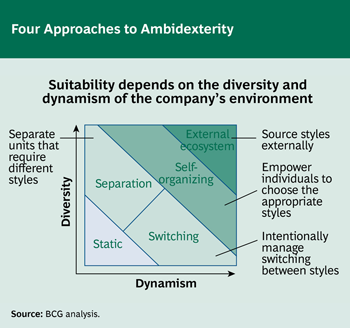
Resolving this contradiction requires ambidexterity—the ability to both explore new avenues and exploit existing ones. Companies need ambidexterity when operating in diverse environments that require different styles of strategy simultaneously, or in dynamic environments that require them to transition between styles over time. 
Companies need to be ambidextrous when operating in both emerging and developed markets, when bringing new products and technologies to market while exploiting existing ones, when integrating startups into their existing business, and in a range of other circumstances. 
The need to develop ambidexterity is widely acknowledged: in a recent BCG survey of 130 senior executives of major public and private companies, fully 90 percent agreed that being able to manage multiple strategy styles and transition between them was an important capability to develop. But this aspiration is hard to realize. Exploration and exploitation require different ways of organizing and managing…. 
…..3M, a company renowned for its culture of innovation, experienced the exploration-exploitation tradeoff in the early 2000s, when it introduced Six Sigma practices in an effort to boost productivity. While the company’s productivity did indeed increase, the same practices reduced 3M’s ability to innovate, as evidenced by a fall in the proportion of revenues from new products.

Picking the Right Approach to Ambidexterity (see the article for details
)


Tuesday, June 19, 2012


It's Time to Rethink Continuous Improvement
RON ASHKENAS
1:25 PM Tuesday May 8, 2012


This has been an issue with me for years and is critical to having a successful growth company…companies must be ambidextrous and chose the right process for a given task. Go to our blog site (http://marketdrivengrowth.blogspot.com/)and look under the articles titled Process: Being Ambidextrous on the left hand column. This IS CRITICAL!!!!!!!!!!!!

Six Sigma, Kaizen, Lean, and other variations on continuous improvement can be hazardous to your organization's health. While it may be heresy to say this, recent evidence from Japan and elsewhere suggests that it's time to question these methods…..
Admittedly, continuous improvement once powered Japan's economy….…But what's happened in Japan? In the past year Japan's major electronics firms have lost an aggregated $21 billion and have been routinely displaced by competitors from China, South Korea, and elsewhere. As Fujio Ando, senior managing director at Chibagin Asset Management suggests, "Japan's consumer electronics industry is facing defeat. "Similarly, Japan's automobile industry has been plagued by a series of embarrassing quality problems and recalls, and has lost market share to companies from South Korea and even (gasp!) the United States.Looking beyond Japan, iconic six sigma companies in the United States, such as Motorola and GE, have struggled in recent years to be innovation leaders. 3M, which invested heavily in continuous improvement, had to loosen its sigma methodology in order to increase the flow of innovation. As innovation thinker Vijay Govindarajan says, "The more you hardwire a company on total quality management, [the more] it is going to hurt breakthrough innovation. The mindset that is needed, the capabilities that are needed, the metrics that are needed, the whole culture that is needed for discontinuous innovation, are fundamentally different….."Customize how and where continuous improvement is applied. One size of continuous improvement doesn't fit all parts of the organization. The kind of rigor required in a manufacturing environment may be unnecessary, or even destructive, in a research or design shop…Question whether processes should be improved, eliminated, or disrupted. Too many continuous improvement projects focus so much on gaining efficiencies that they don't challenge the basic assumptions of what's being done….Assess the impact on company culture. Take a hard look at the cultural implications of continuous improvement. How do they affect day-to-day behaviors? A data-driven mindset may encourage managers to ignore intuition or anomalous data that doesn't fit preconceived notions

Wednesday, September 16, 2009


Welcoming the New, Improving the Old
By SARA BECKMAN
NYT, Sept 6, 2009


An important theme we developed over our blog’s history is the importance for companies to be “ambidextrous”—using multiple processes to achieve business success (see our blog site -- http://marketdrivengrowth.blogspot.com/
- -for a grouping of earlier postings on this subject under the PROCESS-BEING AMBIDEXTROUS category). The focus has been the proper deployment of processes like 6 Sigma and innovative process like the one discussed below. It is my experience that companies tend to latch on to one process (usually 6 Sigma) with a religious fervor trying to adapt it to all situations.


“For decades, companies from Cisco Systems to Staples to Bank of America have worked to embed the basic techniques of Six Sigma, the business approach that relies on measurement and analysis to make operations as efficient as possible.
More recently, in the last 5 to 10 years, they have been told they must master a new set of skills known as “design thinking.” Aiming to help companies innovate, design thinking starts with an intense focus on understanding real problems customers face in their day-to-day lives — often using techniques
derived from ethnographers
(study customers vs. just asking what they want)— and then entertains a range of possible solutions.


To many, the two skill sets don’t fit together well, and Chuck Jones, vice president for global consumer design at Whirlpool, explains why that may be so. Design thinkers, he says, are like quantum physicists, able to consider a world in which anything — like traveling at the speed of light — is theoretically possible. But a majority of people, including the Six Sigma advocates in most corporations, think more like Newtonian physicists — focused on measurement along three well-defined dimensions.
(This is one of the best comparisons I have seen!!)……..


…..To survive, many businesses will have to figure out how to incorporate both approaches. Design thinking offers tools for exploring new markets and opportunities; Six Sigma skills can be applied to improve existing products. Companies that adhere strictly to one or the other risk failure. “The practices that make for success at one time can trap firms and contribute to their downfall at a later time,” says Bob Cole…….


……..the Six Sigma process starts with an assumption about what is good…..Design thinking, meanwhile, inquires as to what is good…..


The different world views, however, can be brought together.
Progressive Insurance has also turned design and Six Sigma techniques into reasonably comfortable bedfellows. In the early 1990s, it started emphasizing showing up at an accident scene and handling situations in real time, according to a 2004 article by Michael Hammer in The Harvard Business Review. That move reflected a designer’s way of thinking about customer needs, but the company was able to execute the idea through its ability to measure, analyze and improve its processes.


Both worlds — the quantum one where designers push boundaries to surprise and delight, and the Newtonian one where workers meet deadlines and margins — are meaningful. The most successful companies will learn to build bridges between them and leverage them both. "

Monday, July 13, 2009


How to Thrive in Turbulent Markets
HBR February 2009
HBR Reprint #: R0902F
by Donald Sull

This is a great article and I strongly urge you order it for its full impact.

Donald metaphorically compares running a business today with a prize fight:

"Uncertainty is the defining characteristic of any boxing match. Fighters
and trainers can study the tapes of past fights or select sparring partners who
simulate an opponent’s style, but they cannot predict a blow-by-blow chronology
of a fight, foresee spikes in confidence, foretell the errant punch that splits
an eyebrow, or anticipate a wily foe’s deliberate shift in tactics…..
Uncertainty is also the defining characteristic of business competition today….
Many managers consider the recent global credit crunch and resulting economic
meltdown to be a one-off—that right hook they never could have seen coming.
Nothing could be further from the truth. In a report, the accounting firm
PricewaterhouseCoopers even summarized the decade ending in 2006 as “10 years of high-speed change” characterized by “unsettling twists and turns,” recounting a
series of events that confounded executives’ plans"


He defines two key characteristics that must be developed to win in this environment:

"Companies can, like the contender Ali, employ agility to spot and exploit
changes in the market. Alternatively, they can rely on their powers of
absorption to withstand market shifts. Some, however, combine both approaches
and display “agile absorption”—the ability to consistently identify and seize
opportunities while retaining the structural characteristics to weather changes.
In unstable times, cultivating and using both capabilities in combination can
help companies not only survive but emerge as true market leaders. "

Three forms of agility were identified:


"Operational agility: is a company’s capacity, within a focused business
model, to find and seize opportunities to improve operations and processes
Portfolio agility: is the ability to quickly and effectively shift
resources, including cash, talent, and managerial attention, out of
less-promising units and into more-attractive ones.
Strategic agility: is the ability to spot and decisively seize the game changers is the essence of strategic agility."

The author highlights 10 forms of absorption with a full description in the article:
"….firms can build absorption in several ways. The obvious levers include
size, diversification, and a war chest of cash. Other factors (high customer
switching costs, low fixed costs, and a powerful patron) can also buffer a firm
against environmental changes, although in less evident ways."


This analysis is reminiscent of an earlier positing highlighting the importance of companies being ambidextrous ( http://www.blogger.com/post-edit.g?blogID=31247814&postID=4143930625579585941) –the ability to run different processes for different reasons. Here, companies must be both agile and tough, skills that will impact the very culture of your company.

Tuesday, March 10, 2009

A value meal at Starbucks? Coming right up
LAUREN SHEPHERD AP Business Writer
Associated Press Archive
February 3, 2009

We have been following this story of the competitive separation dynamics among Starbucks, McDonald’s and Dunkin Donuts. In the context of the Value Map reviewed earlier (http://marketdrivengrowth.blogspot.com/2007/03/competitive-separation-value-map-next.html) For years, Starbucks was C (offered more perceived food value at a higher price) in the Value Map, Duncan Donuts was B, and McDonald’s was A. All was good. However, the constant drive for growth forced all three to expand beyond their niche to the point, that from the Value Map perspective, they are approaching zero separation (it will probably never reach zero which means perfect competition and no one makes money). At the very least, margins will decline. From this article, it appears that the current financial recession is accelerating this process which maybe happening to many of us!!


The allure of the value meal has long seduced penny-pinchers craving a cheeseburger. Now, as the dismal economy slurps up profits, Starbucks Corp. is hoping to find some sales salvation in its own value meal variety.


The tug of war for coffee drinkers has gotten hotter in recent months, with McDonald's Corp. offering new, lower-priced specialty coffee drinks and Dunkin' Donuts advertising value-minded deals. "You've got a lot of options right now for the more price-conscious consumer to save money," said Andrew Hetzel, the founder of coffee consulting group Cafemakers.

Starbucks has yet to offer many details about what Chief Executive Howard Schultz described to investors last week as "several breakfast pairings" at "attractive" prices. More details are expected as early as later this week.

But analysts wonder if the plan will be enough to keep value-seeking customers from abandoning the mermaid for the clown.

The McDonald's drinks, which are now in about half of the company's U.S. stores, have already garnered a following among some former Starbucks customers like Maudie West.
The 86-year-old resident of Kansas City, Kan. says she has an iced mocha from McDonald's "as often as I can get someone to drive through."
"I just absolutely love them," she said. "They're much richer-tasting than Starbucks."
Starbucks is looking to rebound from dismal sales in the U.S. as more consumers cut back on spending in the deepening recession. In its fiscal first quarter report last week, same-store sales -- a key indicator of a retailer's performance -- dropped 10 percent. That's worse than the 8 percent decline in the fiscal fourth quarter.


Even in areas like the Northeast where business has remained fairly strong, some former Starbucks drinkers have been cutting back or abstaining altogether.
Kathryn Lane, a 30-year-old Brooklyn, N.Y. resident, said she used to indulge in a Starbucks latte as a treat about once a week.

"I go about once a month now at most," Lane said.
Lane has not tried the McDonald's drinks since they have yet to come to the New York City market. But she said she would give it a try: "If it was tasty, I would go back."
Restaurants have been increasingly trying to break into the specialty coffee market, which has grown substantially since 1995, when only 2.7 percent of adults drank a specialty coffee drink every day, according to the Specialty Coffee Association of America. In 2008, that percentage stood at 17 percent.

Starbucks won't say whether competition from its lower-priced rivals has contributed to its sales decline. But analysts say the economy may be driving more value-minded consumers to switch brands rather than just cut back.
"It's hard when people automatically see Starbucks as being more expensive," said Stifel Nicolaus analyst Steve West.

McDonald's is halfway through its nationwide launch of its new espresso-based drinks and said sales are hitting or exceeding internal targets. It declined to elaborate but cited the popularity of the drinks as one factor in its better than expected fourth-quarter results.

McDonald's now offers the drinks in about 7,000 of its nearly 14,000 U.S. locations. Although it is still rolling out the beverages, it is already heavily promoting them locally through coupons and samples.

The McCafe drinks are about 65 cents, or about 25 percent, cheaper on average than those at Starbucks. When shots of flavors are added, the savings increase because a flavor shot costs 35 cents each on average at Starbucks. The shots are free at McDonald's.
West, the analyst -- who is not related to Maudie West -- says he thinks the McCafe drinks will do well. Given Starbucks' sales declines, he says, "I've got to imagine some of those people are going to McDonald's."

And while McDonald's is well-known for its value meals, those include only the regular drip coffee, not the new espresso-based drinks -- at least not yet.


Not to be outdone, Dunkin' Donuts is trying to attract value-conscious consumers with specially priced coffee and food combinations, such as a medium drip coffee and an egg white flatbread sandwich for $1.99. The company, which is privately held, doesn't report financial results and declined to give specific figures.
Much of Dunkin's market base is price-sensitive customers, whereas Starbucks' customer base still includes a die-hard core that may be unwilling to trade down on their coffee.
Melanie Helfrich, a 29-year-old from Louisville, Ky., who favors Starbucks lattes was unimpressed by a free sample of a hot mocha latte at her local McDonald's recently.
"I am willing to pay the extra $2 and wait for my drink in order to get a good cup of coffee," she said.

Sunday, March 01, 2009


Process to be an art or science


HBR March 2009 JM Hall and NE Johnson


This is an excellent article from HBR on the importance of choosing the right process for the right challenge. Remember our earlier discussions on the need to be an ambidextrous company—companies always face multiple challenges and “one process does not fit all”

Mass processes are standardized processes that are geared to eliminate variations in output. They’re appropriate when the goal is completely consistent output for a narrow range of products or services. In such cases, all artistic discretion should be eliminated. Steel, cars, and consumer financial services are examples of industries where mass processes are widely applied.
Mass customization uses a scientific process to produce controlled variations in output. Assemble-to-order products like Dell’s personal computers and cars in BMW’s “Build Your Own” program fall into this category. While the number of possible combinations might be enormous (BMW claims more than 130 million configurations), output variability is limited to combinations of predefined components. In many cases, mass customization represents the best of both worlds: control and variation. But when customers demand true customization (“I want a pink computer with a fabric-covered chassis that complements my office”), it will fall short.


Nascent or broken processes can’t produce the consistent output that customers demand. Out-of-control processes are common when a product or process uses radically new materials, technology, or designs. In these situations, managers should consider whether controlling output variation is feasible or desirable. If variation can’t be controlled but customers can be persuaded to value it, an artistic process is the solution. If customers won’t tolerate variation, the focus should be on understanding its causes and creating a standard process. Boeing did this for its new 787 Dreamliner, the first commercial aircraft with a carbon composite airframe: The company conducted test runs to learn how to standardize the process for manufacturing fuselage sections.

Artistic processes leverage variability in the environment to create variations of products or services that customers value. They rely on the judgment and direct experience of craftspeople. Building Steinway pianos, serving passengers on flights, and developing radically new software applications are but a few of the processes that meet those criteria. Before choosing art, it’s critical to make sure that customers really value output variation. Some managers delude themselves into believing they need artistic output when the vast majority of customers really want a standard product.

Tuesday, November 04, 2008


It’s No Time to Forget About Innovation

James Yang
By JANET RAE-DUPREE
Published: November 1, 2008, NYT

This is a very thought provoking article that was referred to me by both Professor James Conley from The Kellogg Sch00l and Denise Fletcher from Affiliated Computer Services. I highly suggest you go back to two earlier postings that discuss efficiency issues for innovation.

"Ambidextrous" companies can handle incremental change and bold initiatives
http://marketdrivengrowth.blogspot.com/2007/06/have-it-both-ways-ambidextrous.html
At 3M, A Struggle Between Efficiency And Creativity
http://marketdrivengrowth.blogspot.com/2007/07/at-3m-struggle-between-efficiency-and.html

A key message is that although these are VERY difficult times, do not sacrifice the future for once you hit the “stall point” of stagnation, all the data suggests it is VERY difficult to breakout of it.As you will see below, I do not agree with all the comments. I invite your thoughts.

BY its very nature, innovation is inefficient. (I am not sure I like this characterization. Innovation is riskier and more uncertain than initiatives targeted to extend or defend the current business but, because of this, they must be managed differently to be efficient—“Manage the cost of failure, not the rate of failure”. The above two posting deal with this in more detail) While blockbusters do emerge, few of the new products or processes that evolve from innovative thinking ultimately survive the test of time. During periods of economic growth, such inefficiencies are chalked up as part of the price of forging into the future.

But these aren’t such times. Wild market gyrations, frozen credit markets and an overall sour economy herald a new round of corporate belt-tightening. Foremost on the target list is anything inefficient. That’s bad news for corporate innovation, and it could spell trouble for years to come, even after the economy turns around.(This just emphasizes the importance of using the right processes for managing uncertainty)

“To be honest, we had a problem with innovation even before the economic crisis. That’s the reason I wrote my book,” says Judy Estrin, former chief technology officer at Cisco Systems and author of “Closing the Innovation Gap.” “We’re focusing on the short term and we’re not planting the seeds for the future.”
In tough times, of course, many companies have to scale back. But, she says: “To quote Obama, you don’t use a hatchet. You use a scalpel. Leaders need to pick and choose with great care.”
There are important things managers can do to ensure that creative forward-thinking doesn’t go out the door with each round of layoffs. Fostering a companywide atmosphere of innovation — encouraging everyone to take risks and to think about novel solutions, from receptionists to corner-suite executives — helps ensure that the loss of any particular set of minds needn’t spell trouble for the entire company. (I do not necessarily agree with this simplistic statement. There are many models that companies are experimenting with to drive innovation. Secondly, there are many functions within a company that demands processes like Six Sigma where you do not necessarily want these folks taking risks.Refer to the "Ambidextrous" companies can handle incremental change and bold initiatives" posting)

She suggests instilling five core values to entrench innovation in the corporate mind-set: questioning, risk-taking, openness, patience and trust. All five must be used together — risk-taking without questioning leads to recklessness, she says, while patience without trust sets up an every-man-for-himself mentality.

In an era of Six Sigma black belts and brown belts, Ms. Estrin urges setting aside certain efficiency measures in favor of what she calls “green-thumb leadership” — a future-oriented management style that understands, and even encourages, taking risks. Let efficiency measures govern the existing “factory farm,” she says, but create greenhouses and experimental gardens along the sides of the farm to nurture the risky investments that likely will take a number of years to bear fruit. (Refer back to the postings highlighted above)

“I’m not suggesting you only cut from today’s stuff and keep the future part untouched,” she says. “You have to balance it.” (This is critical. Although easier said than done, leaders must try to maintain their business renewal efforts while meeting their current requirements. Look at taking “the scalpel” carefully, not just pruning initiatives that may not bear fruit immediately but are required for renewal. Try to prioritize within each category – defending the base, extending it, and renewal.)

Yet even that approach has its drawbacks. Companies that create silos of innovation by designating one group as the “big thinkers” while making others handle day-to-day concerns risk losing their innovative edge if any of the big thinkers leave the company or ultimately must be laid off.

Innovation has to be embedded in the daily operation, in the entire work force,” says Jon Fisher, a business professor, serial entrepreneur, and author of “Strategic Entrepreneurism,” which advocates building a start-up’s business from the beginning with an eye toward selling the company. “A large acquirer’s interest in a start-up or smaller company is binary in nature: They either want you or they don’t, based on the innovation you have to offer. The best way to foster innovation is to create something, put it to the test, build a good company and then get it under the umbrella of a world-renowned company to move it forward.”
David Thompson, chief executive and co-founder of Genius.com Inc., based in San Mateo, Calif., says that innovation “has a bad name in down times” but that “bad times focus the mind and the best-focused minds in the down times are looking for the opportunities.”

“You do have to batten down the hatches and reduce expenses, but you can’t do it at the expense of the big picture,” Mr. Thompson adds. “You always have to keep in mind the bigger picture that’s coming down the road in two or three years.

“The last thing you want to do with innovation is just throw money at it. It’s a very tricky balance.” (refer to the blog postings from above)

In fact, hard times can be the source of innovative inspiration, says Chris Shipley, a technology analyst and executive producer of the DEMO conferences, where new ideas make their debuts. “Some of the best products and services come out of some of the worst times,” she says. In the early 1990s, tens of millions of dollars had gone down the drain in a futile effort to develop “pen computing” — an early phase of mobile computing — and a recession was shriveling the economic outlook.

Yet the tiny Palm Computing managed to revitalize the entire industry in a matter of months by transforming itself overnight from a software maker into a hardware company.

“Our biggest challenge right now is fear,” she says. “The worst thing that a company can do right now is go into hibernation, into duck-and-cover. If you just sit on your backside and wait for things to get better, they’re not going to. They’re going to get better for somebody, but not necessarily for you.”

HOWARD LIEBERMAN, also a serial entrepreneur and founder of the Silicon Valley Innovation Institute, says innovation breeds effectiveness. It’s not about efficiency, he argues. “Efficiency is for bean counters,” he says. “It’s not for C.E.O.’s or inventors or founders.”(I would counter this comment a bit. There are VERY efficient tools to manage projects that are highly uncertain. The key, as discussed in the early blog postings noted above is choosing the right process. We cannot afford to do innovation inefficiently)
The current economic downturn comes as no surprise to him, he says, because it mirrors the downturn at the time of the dot-com bust. Then and now, the companies that survive are those that keep creativity and innovation foremost.
“Creativity doesn’t care about economic downturns,” Mr. Lieberman says. “In the middle of the 1970s, when we were having a big economic downturn, both Apple and Microsoft were founded. Creative people don’t care about the time or the season or the state of the economy; they just go out and do their thing.”

Monday, January 14, 2008


Another view of Six Sigma and Innovation: Starwood Hotels: Rubbing Customers The Right Way
Massages and other unlikely Six Sigma ventures are winners at Starwood Hotels


Business Week OCTOBER 8, 2007


We discussed the choice of the right process to drive innovation in the following positings. I came down pretty hard on Six Sigma. Here is an example where Six Sigma played an important role in innovation.


At 3M, A Struggle Between Efficiency And Creativity -July 2, 2007
http://marketdrivengrowth.blogspot.com/2007/07/at-3m-struggle-between-efficiency-and.html

Have It Both Ways –June 18, 2007
"Ambidextrous" companies can handle incremental change and bold initiatives
http://marketdrivengrowth.blogspot.com/2007/06/have-it-both-ways-ambidextrous.html


In January, 2006, the Westin Chicago River North hotel was picked to pilot a project, dubbed Unwind, for the upscale hotel chain. The purpose: to think up a set of nightly activities that would draw guests out of their rooms and into the lobby where they could mingle, develop a greater loyalty to the hotel group, and maybe spend a little more money. Westin spied an opportunity after a study found that 34% of frequent travelers feel lonely away from home. The Unwind project led the Westin to develop dozens of activities, including massages, at the Chicago hotel.


Instead of hiring the usual ethnographers or consultants, Westin owner Starwood Hotels & Resorts Worldwide Inc. (HOT ) turned to Six Sigma, a management process known for reducing defects and increasing efficiency. It was a surprising move given Six Sigma's rap as a creativity killer. But under Geoffrey A. Ballotti, president of Starwood's North America Div., the company is using Six Sigma's strengths to promote innovation--and generate tens of millions in new revenue. Combining creativity and efficiency is a delicate managerial maneuver that few service companies can pull off.

Starwood succeeded, in large part, because it began with a culture of creativity before introducing the management tool. (Critical!!!) Design has long played a major role in the company, with noted architect David Rockwell designing its hip W Hotels brand back in the '90s.

Starwood gets a boost out of Six Sigma by using its techniques to dream up projects across the company. Massage is just one of hundreds of ventures done this way. This year's food and beverage engineering program, which rejiggers the choices on room-service and catering menus based on their popularity, has generated $20 million in extra revenue.

In 2006, programs developed under Six Sigma delivered more than $100 million in profit to its bottom line. As a result, the White Plains (N.Y.) company is one of the world's most profitable hotel operators: Its net margin is nearly 15%, higher than those of rivals Hilton Hotels Corp. (HLT ) and Marriott International Inc. (MAR ) "We have been driving our margin growth faster than our competitors," says Ballotti. "When people ask why, I point to Six Sigma."

The group that runs the effort is headed by Brian Mayer, who claims the quirky title of vice-president for Six Sigma, operation innovation, and room support. "I grew up in the hospitality industry," says Mayer, whose grandfather and father ran catering businesses. "The joke is that I was born in a chafing dish."

Since the program launched in 2001, Mayer's crew has trained 150 employees as "black belts" and more than 2,700 as "green belts" in the arts of Six Sigma. Based mostly at the hotels, black belts oversee the projects while green belts hammer out the details. The key to their success, says Mayer, is that instead of acting like "suits" imposing their will from "corporate," the Six Sigma specialists operate more like partners who help local hotels meet their own objectives. Indeed, almost 100% of the creative concepts come from in-house staff. And every project must be overseen by a hotel employee. "By focusing on their goals and budgets it enables us to become a partner in the operation," says Mayer.


SWAT TEAMS

The innovation process begins when hotel teams pitch Mayer's group on a new idea. "They fight for our resources," says Mayer. A Six Sigma Council composed of Ballotti and his 13 direct reports, including his senior vice-president for sales and marketing, then evaluates an idea's merit based on the division's priorities and the project's expected payoff. If the council approves a project, black belts and green belts are deployed like SWAT teams to the hotels to carry it out.

In the case of Unwind, a Six Sigma team in January, 2005, brainstormed with a group from the Westin Chicago River North Hotel that included the directors of rooms, food and beverages, and sales. In that meeting, the hotel's fitness director "came up and said: 'Why don't we do massage?'" says Peter Simoncelli, the hotel's general manager.

The team liked the idea and started to design the experience. First up was figuring out the logistics: getting the massage chairs, choosing the uniform of the masseuse, determining the best location for the table. In October, 2005, the hotel staged a dry run. The team quickly learned they had a problem: The guests wanted the complimentary massage to last longer than the hotel anticipated. "We had to come up with a diplomatic way of saying there is a limited amount of time in the massage chair," says Simoncelli. After completing the pilot in a few weeks, the Six Sigma team turned over the project to its hotel sponsor, in this case the rooms director. Last year the hotel introduced massage and found a nice surprise: Later on, the revenues from paid massages in the hotel spa hit an all-time high, rising 30% over the previous year.

After a prototype rolls out, green belts shift into analytics mode. (In the language of our Market Driven Growth process, testing the prototype is the inductive part of our analysis while the green belt work is the deductive component) They spend a lot of time with the E-Tool, a proprietary Web-based system that allows Starwood to monitor a slew of performance metrics to gauge the success or failure of a new project. E-Tool lets hotel managers rapidly spread and drive consistent execution of each project. That's no easy task at Starwood, which owns, manages, or franchises 800 hotels, and rolls out new projects to them every two weeks. Green belts enter every project into the E-Tool, which currently contains 3,000 to 4,000 items. The entries are detailed and include photographs and project descriptions as well as how-to instructions. The Unwind program alone produced 120 new activities--one for each Westin hotel, including traditional fire dancing in Fiji and Chinese watercolor painting in Beijing. "I probably will make 50% fewer mistakes than if I had rolled out a project myself," says Simoncelli.

Some projects lead to big cost savings and a healthier workplace. Consider a hotel safety effort that was made mandatory for all North American hotels. Starwood launched the initiative in early 2004 after executives noticed that workers' compensation claims were skyrocketing. A Six Sigma team researched the problem and discovered the biggest cause of accidents were slips and falls, and housekeepers often suffered from back strains. The team developed new work processes, including a stretching routine required for all housekeepers and new cleaning tools with longer handles. In the past three years, Starwood has slashed the number of workers' claims in half, and their cost has fallen 69%. (Classic 6 Sigma type project)

The latest effort is an initiative to drive down the company's energy costs. Thanks to a program that offers energy consumption tips, such as shutting off computers, Starwood estimates it will cut its power bill this year by about $11 million. Part of the program requires hotels to replace incandescent lights with compact fluorescent bulbs in 75% of their rooms. There was a lot of pushback from hotel staff who felt the new bulbs would not throw off such a pleasing light. But a Six Sigma group allayed those concerns by setting up a dozen rooms with different bulbs. "We had top leaders figuring out which one was best," says Ballotti. "The collective power of getting these folks together is just amazing." (Classic 6 Sigma type project)

Monday, July 02, 2007


At 3M, A Struggle Between Efficiency And Creativity


How CEO George Buckley is managing the yin and yang of discipline and imagination
BW 6/11/07

Our last posting highlighted the need for companies to be ambidextrous – use the right process for the right thing. One danger I have found in my own experience is that often new processes or methodologies become a religion that tend to dominate all aspects of corporate life. When we first started deploying our Market Driven Growth process at DuPont, we ran smack into the Six Sigma culture that had been prevalent for about two years. When I tried to point out some of the limitations of Six Sigma in the context of innovation as discussed below, I got my hand severely slapped. I want to emphasize that Six Sigma helped a large part of DuPont but we ran into many of the issues highlighted below re growth. I decided to site the whole article because it is extremely powerful. As always, I highlighted some key thoughts……..

Not too many years ago, the temple of management was General Electric (GE ). Former CEO Jack Welch was the high priest, and his disciples spread the word to executive suites throughout the land. One of his most highly regarded followers, James McNerney, was quickly snatched up by 3M after falling short in the closely watched race to succeed Welch. 3M's board considered McNerney a huge prize, and the company's stock jumped nearly 20% in the days after Dec. 5, 2000, when his selection as CEO was announced. The mere mention of his name made everyone richer.

McNerney was the first outsider to lead the insular St. Paul (Minn.) company in its 100-year history. He had barely stepped off the plane before he announced he would change the DNA of the place. His playbook was vintage GE. McNerney axed 8,000 workers (about 11% of the workforce), intensified the performance-review process, and tightened the purse strings at a company that had become a profligate spender. He also imported GE's vaunted Six Sigma program—a series of management techniques designed to decrease production defects and increase efficiency. Thousands of staffers became trained as Six Sigma "black belts." The plan appeared to work: McNerney jolted 3M's moribund stock back to life and won accolades for bringing discipline to an organization that had become unwieldy, erratic, and sluggish.

Then, four and a half years after arriving, McNerney abruptly left for a bigger opportunity, the top job at Boeing (BA ). Now his successors face a challenging question: whether the relentless emphasis on efficiency had made 3M a less creative company. That's a vitally important issue for a company whose very identity is built on innovation. After all, 3M is the birthplace of masking tape, Thinsulate, and the Post-it note. It is the invention machine whose methods were consecrated in the influential 1994 best-seller Built to Last by Jim Collins and Jerry I. Porras. But those old hits have become distant memories. It has been a long time since the debut of 3M's last game-changing technology: the multilayered optical films that coat liquid-crystal display screens. At the company that has always prided itself on drawing at least one-third of sales from products released in the past five years, today that fraction has slipped to only one-quarter.

Those results are not coincidental. Efficiency programs such as Six Sigma are designed to identify problems in work processes—and then use rigorous measurement to reduce variation and eliminate defects. When these types of initiatives become ingrained in a company's culture, as they did at 3M, creativity can easily get squelched (this is the real danger of creating the "religion"). After all, a breakthrough innovation is something that challenges existing procedures and norms. "Invention is by its very nature a disorderly process," says current CEO George Buckley, who has dialed back many of McNerney's initiatives. "You can't put a Six Sigma process into that area and say, well, I'm getting behind on invention, so I'm going to schedule myself for three good ideas on Wednesday and two on Friday. That's not how creativity works." McNerney declined to comment for this story.

PROUD CREATIVE CULTURE

The tension that Buckley is trying to manage—between innovation and efficiency—is one that's bedeviling CEOs everywhere(the need to be ambidextrous--see below). There is no doubt that the application of lean and mean work processes at thousands of companies, often through programs with obscure-sounding names such as ISO 9000 and Total Quality Management, has been one of the most important business trends of past decades. But as once-bloated U.S. manufacturers have shaped up and become profitable global competitors, the onus shifts to growth and innovation, especially in today's idea-based, design-obsessed economy. While process excellence demands precision, consistency, and repetition, innovation calls for variation, failure, and serendipity (I disagree here. The issue is not process excellence, it is the process you apply. A rigouous application of Options Management deals with the issues of variatiojn and failure).


Indeed, the very factors that make Six Sigma effective in one context can make it ineffective in another. Traditionally, it uses rigorous statistical analysis to produce unambiguous data that help produce better quality, lower costs, and more efficiency. That all sounds great when you know what outcomes you'd like to control. But what about when there are few facts to go on—or you don't even know the nature of the problem you're trying to define? "New things look very bad on this scale," says MITSloan School of Management professor Eric von Hippel, who has worked with 3M on innovation projects that he says "took a backseat" once Six Sigma settled in. "The more you hardwire a company on total quality management, [the more] it is going to hurt breakthrough innovation," adds Vijay Govindarajan, a management professor at Dartmouth's Tuck School of Business. "The mindset that is needed, the capabilities that are needed, the metrics that are needed, the whole culture that is needed for discontinuous innovation, are fundamentally different.


"The exigencies of Wall Street are another matter. Investors liked McNerney's approach to boosting earnings, which may have sacrificed creativity but made up for it in consistency. Profits grew, on average, 22% a year (this is cost driven earnings growth which generally is not sustainable). In Buckley's first year, sales approached $23 billion and profits totaled $1.4 billion, but two quarterly earnings misses and a languishing stock made it a rocky ride. In 2007, Buckley seems to have satisfied many skeptics on the Street, convincing them he can ignite top-line growth without killing the McNerney-led productivity improvements. Shares are up 12% since January.

Buckley's Street cred was hard-won. He's nowhere near the management rock star his predecessor was. McNerney could play the President on TV. He's tall and athletic, with charisma to spare. Buckley is of average height, with a slight middle-age paunch, an informal demeanor, and a scientist's natural curiosity. In the office he prefers checked shirts and khakis to suits and ties. He's bookish and puckish, in the way of a tenured professor.

Buckley, in short, is just the kind of guy who has traditionally thrived at 3M. It was one of the pillars of the "3M Way" that workers could seek out funding from a number of company sources to get their pet projects off the ground. Official company policy allowed employees to use 15% of their time to pursue independent projects. The company explicitly encouraged risk and tolerated failure. 3M's creative culture foreshadowed the one that is currently celebrated unanimously at Google (GOOG ).

Perhaps all of that made it particularly painful for 3M's proud workforce to deal with the hard reality the company faced by the late '90s. Profit and sales growth were wildly erratic. It bungled operations in Asia amid the 1998 financial crisis there. The stock sat out the entire late '90s boom, budging less than 1% from September, 1997, to September, 2000. The flexibility and lack of structure, which had enabled the company's success, had also by then produced a bloated staff and inefficient workflow. So McNerney had plenty of cause to whip things into shape (there were problems).

GREEN-BELT TRAINING REGIMEN

One of his main tools was Six Sigma, which originated at Motorola (MOT ) in 1986 and became a staple of corporate life in the '90s after it was embraced by GE. The term is now so widely and divergently applied that it's hard to pin down what it actually means. At some companies, Six Sigma is plainly a euphemism for cost-cutting. Others explain it as a tool for analyzing a problem (high shipping costs, for instance) and then using data to solve each component of it. But on a basic level, Six Sigma seeks to remove variability from a process. In that way you avoid errors, or defects, and increase predictability (technically speaking, Six Sigma quality has come to be accepted as no more than 3.4 defects per million) (remember, we always say a company has to learn to manage uncertainty or variability in innovation, not eliminate it!!).

At 3M, McNerney introduced the two main Six Sigma tools. The first and more traditional version is an acronym known as DMAIC (pronounced "dee-may-ic"), which stands for: define, measure, analyze, improve, control. These five steps are the essence of the Six Sigma approach to problem solving. The other flavor is called Design for Six Sigma, or DFSS, which purports to systematize a new product development process so that something can be made to Six Sigma quality from the start (DFSS is the real danager when applied to projects that are Options or Horizon 2 or 3 projects).

Thousands of 3Mers were trained as black belts, an honorific awarded to experts who often act as internal consultants for their companies. Nearly every employee participated in a several-day "green-belt" training regimen, which explained DMAIC and DFSS, familiarized workers with statistics, and showed them how to track data and create charts and tables on a computer program called Minitab (the formation of the "religion". I took my training 3 months before I retired from DuPont). The black belts fanned out and led bigger-scale "black-belt projects," such as increasing production speed 40% by reducing variations and removing wasted steps from manufacturing. They also often oversaw smaller "green-belt projects," such as improving the order fulfillment process. This Six Sigma drive undoubtedly contributed to 3M's astronomical profitability improvements under McNerney; operating margins went from 17% in 2001 to 23% in 2005.

While Six Sigma was invented as a way to improve quality, its main value to corporations now clearly is its ability to save time and money. McNerney arrived at a company that had been criticized for throwing cash at problems. In his first full year, he slashed capital expenditures 22%, from $980 million to $763 million, and 11% more to a trough of $677 million in 2003. As a percentage of sales, capital expenditures dropped from 6.1% in 2001 to just 3.7% in 2003. McNerney also held research and development funding constant from 2001 to 2005, hovering over $1 billion a year. "If you take over a company that's been living on innovation, clearly you can squeeze costs out," says Charles O'Reilly, a Stanford Graduate School of Business management professor. "The question is, what's the long-term damage to the company?"

Under McNerney, the R&D function at 3M was systematized in ways that were unheard of and downright heretical in St. Paul, even though the guidelines would have looked familiar at many other conglomerates. Some employees found the constant analysis stifling. Steven Boyd, a PhD who had worked as a researcher at 3M for 32 years before his job was eliminated in 2004, was one of them. After a couple of months on a research project, he would have to fill in a "red book" with scores of pages worth of charts and tables, analyzing everything from the potential commercial application, to the size of the market, to possible manufacturing concerns.

Traditionally, 3M had been a place where researchers had been given wide latitude to pursue research down whatever alleys they wished. After the arrival of the new boss, the DMAIC process was laid over a phase-review process for innovations—a novelty at 3M. The goal was to speed up and systematize the progress of inventions into the new-product pipeline. The DMAIC questions "are all wonderful considerations, but are they appropriate for somebody who's just trying to...develop some ideas?" asks Boyd. The impact of the Six Sigma regime, according to Boyd and other former 3Mers, was that more predictable, incremental work took precedence over blue-sky research. "You're supposed to be having something that was going to be producing a profit, if not next quarter, it better be the quarter after that," Boyd says.

For a long time, 3M had allowed researchers to spend years testing products. Consider, for example, the Post-it note. Its inventor, Art Fry, a 3M scientist who's now retired, and others fiddled with the idea for several years before the product went into full production in 1980. Early during the Six Sigma effort, after a meeting at which technical employees were briefed on the new process, "we all came to the conclusion that there was no way in the world that anything like a Post-it note would ever emerge from this new system," says Michael Mucci, who worked at 3M for 27 years before his dismissal in 2004. (Mucci has alleged in a class action that 3M engaged in age discrimination; the company says the claims are without merit.)

There has been little formal research on whether the tension between Six Sigma and innovation is inevitable. But the most notable attempt yet, by Wharton School professor Mary Benner and Harvard Business School professor Michael L. Tushman, suggests that Six Sigma will lead to more incremental innovation at the expense of more blue-sky work (in our terms, this would be Extend and Defend or Horizon 1 projects). The two professors analyzed the types of patents granted to paint and photography companies over a 20-year period, before and after a quality improvement drive. Their work shows that, after the quality push, patents issued based primarily on prior work made up a dramatically larger share of the total, while those not based on prior work dwindled.

Defenders of Six Sigma at 3M claim that a more systematic new-product introduction process allows innovations to get to market faster. But Fry, the Post-it note inventor, disagrees. In fact, he places the blame for 3M's recent lack of innovative sizzle squarely on Six Sigma's application in 3M's research labs. Innovation, he says, is "a numbers game. You have to go through 5,000 to 6,000 raw ideas to find one successful business." Six Sigma would ask, why not eliminate all that waste and just come up with the right idea the first time? That way of thinking, says Fry, can have serious side effects. "What's remarkable is how fast a culture can be torn apart," says Fry, who lives in Maplewood, Minn., just a few minutes south of the corporate campus and pops into the office regularly to help with colleagues' projects. "[McNerney] didn't kill it, because he wasn't here long enough. But if he had been here much longer, I think he could have."

REINVIGORATED WORKFORCE

Buckley, a PhD chemical engineer by training, seems to recognize the cultural ramifications of a process-focused program on an organization whose fate and history is so bound up in inventing new stuff. "You cannot create in that atmosphere of confinement or sameness," Buckley says. "Perhaps one of the mistakes that we made as a company—it's one of the dangers of Six Sigma—is that when you value sameness more than you value creativity, I think you potentially undermine the heart and soul of a company like 3M."

In recent years, the company's reputation as an innovator has been sliding. In 2004, 3M was ranked No. 1 on Boston Consulting Group's Most Innovative Companies list (now the BusinessWeek/BCG list). It dropped to No. 2 in 2005, to No. 3 in 2006, and down to No. 7 this year. "People have kind of forgotten about these guys," says Dev Patnaik, managing associate of innovation consultancy Jump Associates. "When was the last time you saw something innovative or experimental coming out of there?"

Buckley has loosened the reins a bit by removing 3M research scientists' obligation to hew to Six Sigma objectives. There was perhaps a one-size-fits-all approach to the application of Six Sigma as the initial implementation got under way, says Dr. Larry Wendling, a vice-president who directs the "R" in 3M's R&D operation. "Since [McNerney] was driving it to the organization, you know, there were metrics established across the organization and quite frankly, some of them did not make as much sense for the lab as they did other parts of the organization," Wendling says. What sort of metrics? Keeping track of how many black-belt and green-belt projects were completed, for one.

In fact, it's not uncommon for Six Sigma to become an end unto itself. That may be appropriate in an operations context—at the end of the year, it's easy enough for a line manager to count up all the money he's saved by doing green-belt projects. But what 3Mers came to realize is that these financially definitive outcomes were much more elusive in the context of a research lab. "In some cases in the lab it made sense, but in other cases, people were going around dreaming up green-belt programs to fill their quota of green-belt programs for that time period," says Wendling. "We were letting, I think, the process get in the way of doing the actual invention."

To help get the creative juices flowing, Buckley is opening the money spigot—hiking spending on R&D, acquisitions, and capital expenditures. The overall R&D budget will grow 20% this year, to $1.5 billion. Even more significant than the increase in money is Buckley's reallocation of those funds. He's funneling cash into what he calls "core" areas of 3M technology, 45 in all, from abrasives to nanotechnology to flexible electronics. That is another departure from McNerney's priorities; he told BusinessWeek in 2004 that the 3M product with the most promise was skin-care cream Aldara, the centerpiece to a burgeoning pharmaceuticals business. In January, Buckley sold the pharma business for $2 billion.

Quietly, the McNerney legacy is being revised at 3M. While there is no doubt the former CEO brought some positive change to the company, many workers say they are reinvigorated now that the corporate emphasis has shifted from profitability and process discipline to growth and innovation. Timm Hammond, the director of strategic business development, says "[Buckley] has brought back a spark around creativity." Adds Bob Anderson, a business director in 3M's radio frequency identification division: "We feel like we can dream again."


Remember, we must be ambidextrous-- deploy Options Management to gain knowledge in a time and cost effective way; a process like Discovery Driven Planning for scaling; and, Six Sigma for optimization:


Monday, June 18, 2007


Have It Both Ways


"Ambidextrous" companies can handle incremental change and bold initiatives


By Jeneanne Rae Viewpoint:
BW 6/11/07 The debate: Six Sigma vs. Innovation


The next few postings will deal with the critically important topic of creating the right corporate climate for innovation. Specifically, when to use tools like 6 Sigma and when not to when driving growth through innovation. I had many battle scars when I first introduced our Market Driven Growth (MDG) process at DuPont that was deep in the 6 Sigma culture; the 6 sigma black belts wanted to do everything with their methodologies.

The following visual really does it for me. We discuss this in our executive ed class at Kellogg and it is a critical component of implementing the MDG process at our clients.


The three distinct phases of an initiative must be recognized and managed differentially – the “ambidextrous” company. The work at the early stages of a new initiative is driving for strategic clarity. The metric is knowledge and the tool is Options Management. The next phase, the zone of highest business risk-- the combination of uncertainty and spend rate – is where you selected a single path and you must scale it in an environment of relatively high uncertainty (represented by the rapids). The metric is revenue growth and the tool is Discovery Driven Planning. The final stage – optimization – is the region of low uncertainty but execution is critical. The metric is earnings growth and the tool is 6 Sigma. Finally, note the different types of personal needed at each phase. It is critically important to match the DNA of individuals with the task.
Now for the article.

"I can't stand this," said a senior executive of a Standard & Poor's (MHP ) 500 company recently. "One minute the management team is telling us to innovate, and the next minute they are giving us our marching orders in deploying Six Sigma. It's crazy to tell people they should be focused on becoming more efficient while at the same time you want them to explore untapped growth potential. This is making me nuts."

The objectives of Six Sigma seem noble enough for any organization. So what's the rub with simultaneous efforts to innovate? By its nature, Six Sigma fosters a very low tolerance for risk because risk increases variation.

Innovation, on the other hand, seeks to brave undiscovered, uncertain territory. Such fledgling efforts are inherently inefficient. Innovation requires a tolerance for risk-taking and failure.

A corporate culture dominated by Six Sigma management theory will be inclined toward inwardly focused, continuous, incremental types of improvements in process, customer service, systems, operations. A culture that fosters disruptive innovation will be more entrepreneurial, outwardly focused on new markets, technologies, and business models. You explore big new growth platforms that add significant chunks of revenue and profit.

Given the huge management and cultural implications inherent in each approach, it would be difficult to launch both efforts at the same time. Most organizations, like General Electric (GE ), become grounded in one and then attempt the other. In GE's case, Six Sigma came first, and its new innovation initiative, Ecomagination, is now rolling out.

In a Harvard Business Review article, "The Ambidextrous Organization," Charles O'Reilly III and Michael Tushman, business school professors at Stanford and Harvard, respectively, acknowledge the paradox of exploitative vs. explorative efforts. They conclude that smart companies separate the more ambitious efforts at innovation from ongoing efforts at continuous improvement. That allows for different processes, structure, and cultures to emerge within the same company.

An "ambidextrous" organization, they write, has independent project teams integrated into the existing management hierarchy. A tightly integrated senior team makes sure the activities of the right hand don't work at cross-purposes with the goals of the left. Both the traditional business and the fledglings report to the same executive team but are managed under a very different set of rules, depending on where each is in its maturity cycle. Remarkably, in the professors' study of 35 attempts at breakthrough innovation, ambidextrous structures were successful 90% of the time. Other models, such as cross-functional teams and unsupported skunkworks-style groups, were successful less than 25% of the time. Jim Burnick, senior vice-president for quality and productivity at Bank of America (BAC ) and leader of the bank's innovation efforts, says that if managed properly Six Sigma and innovation can go hand in hand. Thanks to Six Sigma, "Paragraph it is now possible for us to think as one organization across fiefdoms and business units to improve every type of customer's experience. This ends up as business-model innovation, which in the banking business is very uncommon."

Here are three strategies for managing incremental and disruptive innovative initiatives simultaneously:


- Separate the efforts. Don't expect people running mature businesses to behave the same as those in charge of startups. Each type has its own incentives, organizations, and talent needs.


- Appoint an ambidextrous senior manager to oversee both efforts. A general manager with responsibility for both traditional and new businesses will foster efficiency by sharing such resources as HR, marketing, and finance, and by promoting integration of the initiatives when the time is right.


-Support both teams appropriately. Don't shortchange one over the other. It kills me to see so much investment in reengineering, training, and employee time being poured into Six Sigma initiatives in the name of cost savings when innovation gets starved for critical research requirements like white-space analysis, ethnographic research, or prototyping. It's as if leadership believes companies can shrink their way to greatness.


Innovation and Six Sigma are different methods that beget different results and require different management styles. They can coexist. Just recognize that each requires its own formula for success.